Latest
Ex-Atiku Youth DG, Rowland, Makes U-Turn: Returns To PDP 26 Days After Joining ADC

Ex-Atiku Youth DG, Rowland, Makes U-Turn: Returns To PDP 26 Days After Joining ADC
Abuja, Nigeria – In a dramatic political twist, Comrade Odih Rowland, former Director-General of the Atiku Youth Wing Campaign Organisation, has returned to the Peoples Democratic Party (PDP), less than a month after defecting to the African Democratic Congress (ADC).
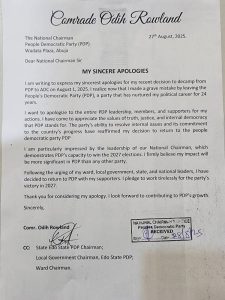
Rowland, a prominent youth mobilizer and longtime PDP member, had announced his departure on August 1, 2025, citing “political realignment.” His move sparked discussions about growing dissatisfaction within the opposition party. However, in a letter dated August 27, 2025, titled “My Sincere Apologies”, Rowland admitted that his decision to leave was a mistake, tendering an unreserved apology to PDP leadership.
“A Grave Mistake”: Rowland Explains His Return
In the apology letter, Rowland acknowledged his regret for leaving a party he had called home for over two decades.
“I realise now that I made a grave mistake by leaving the Peoples Democratic Party (PDP), a party that has nurtured my political career for 24 years,” he wrote.
The youth advocate lauded the PDP’s enduring commitment to “truth, justice, and internal democracy,” while also commending the party’s ability to resolve internal disputes—a quality he described as essential for a party seeking to return to power in 2027.
Rowland emphasized that his decision followed extensive consultations with leaders at the ward, local government, state, and national levels. He pledged to mobilize supporters for the PDP’s victory in the upcoming elections.
Leadership and the 2027 Elections
One striking element of Rowland’s letter was his praise for the PDP National Chairman’s leadership style. He noted that the chairman’s approach to unity and inclusiveness convinced him that the PDP remains Nigeria’s most credible opposition platform.
“I am particularly impressed by the leadership of our National Chairman, which demonstrates PDP’s capacity to win the 2027 elections,” Rowland declared.
His statement comes at a time when the PDP is seeking to reassert itself as Nigeria’s leading opposition party against the ruling All Progressives Congress (APC). With former Vice President Atiku Abubakar still a central figure in the PDP’s orbit, Rowland’s return is being interpreted as a signal that the party retains influence over its grassroots youth leaders.
PDP’s Response: A Symbol of Endurance
The PDP officially welcomed Rowland back at its National Headquarters in Abuja on Thursday. Party officials described his return as “a testament to the PDP’s enduring appeal and unity in the face of challenges.”
One senior PDP leader, who spoke on condition of anonymity, suggested that defections and subsequent returns are part of Nigeria’s dynamic political landscape, but Rowland’s quick U-turn highlights the PDP’s capacity to remain attractive to its former members.
The move is expected to boost morale within the party’s youth wing, particularly as the 2027 general elections approach.
A Pattern of Political Defections in Nigeria
Rowland’s defection and swift return mirror a broader trend in Nigerian politics, where party loyalty is often fluid. Over the years, high-profile politicians such as former governors, senators, and ministers have switched allegiances multiple times, citing ideological differences, leadership disputes, or strategic electoral positioning.
Political analysts argue that defections are not always signs of weakness but can reflect the complex negotiations and power shifts that characterize Nigerian democracy.
Globally, political realignments are also common. In South Africa, the African National Congress (ANC) has faced defections to opposition parties, though many politicians eventually return when political tides shift. Similarly, in India, defections and re-alignments are frequent in regional and national politics, as leaders reposition themselves ahead of elections.
What Rowland’s Return Means for PDP
Rowland’s return carries symbolic weight for several reasons:
-
Youth Mobilization – As a former youth campaign director for Atiku, he commands influence among politically active young Nigerians, a demographic that will be decisive in 2027.
-
Perception of Unity – His public apology and recognition of PDP’s “internal democracy” may help counter narratives that the party is fractured beyond repair.
-
Strategic Timing – Coming less than a month after leaving, the reversal signals that alternative platforms like the ADC may still struggle to retain high-profile defectors.
However, critics caution that frequent defections highlight deeper issues in Nigerian political culture, such as the absence of strong ideological commitments and the dominance of personal ambition over policy-driven politics.
Reactions Across Nigeria
The news of Rowland’s return has generated mixed reactions. Some PDP supporters welcomed him warmly, praising his humility and willingness to admit a mistake. Others, however, criticized what they described as “political inconsistency.”
On social media, users debated whether his return was motivated by genuine conviction or by political expediency. A Twitter user commented:
“This is why Nigerians don’t trust politicians—jumping from party to party and back again within weeks. Where is the ideology?”
Another responded more favorably:
“It takes courage to admit when you’re wrong. Rowland’s apology shows he values unity over ego. PDP needs more of that ahead of 2027.”
See the letter below: